Why Crawl Spaces Are Radon's Easiest Way In
A concrete slab at least slows radon down. A crawl space with exposed dirt doesn't — the soil gas rises straight off the ground into the air under your floor, and the stack effect pulls it up into the living space all heating season. In a county whose health department reports 60 percent of samples elevated, a dirt-floor crawl space is the foundation type we most expect to see high numbers from — and the older farmhouses, river-bottom places, and additions around Great Falls, the Sun River valley, and the small towns have plenty of them.
Sub-Membrane Depressurization: The Crawl Space Fix
The crawl space version of radon mitigation is called sub-membrane depressurization, and it works on the same physics as a slab system — it just builds the “slab” first:
- The membrane. Heavy-gauge plastic sheeting is laid across the entire exposed soil floor, overlapped at the seams, run up the foundation walls, and sealed to them.
- The seal. Seams, piers, and penetrations are taped and sealed so the space under the membrane becomes one connected air zone.
- The suction. A pipe passes through the membrane, and the inline fan holds the soil side at lower pressure than the crawl space — radon follows the pipe out above the roofline instead of seeping up into the house.
- The verification. Same rule as every system we install: a post-mitigation test proves the number dropped below 4.0 pCi/L, or we keep working.
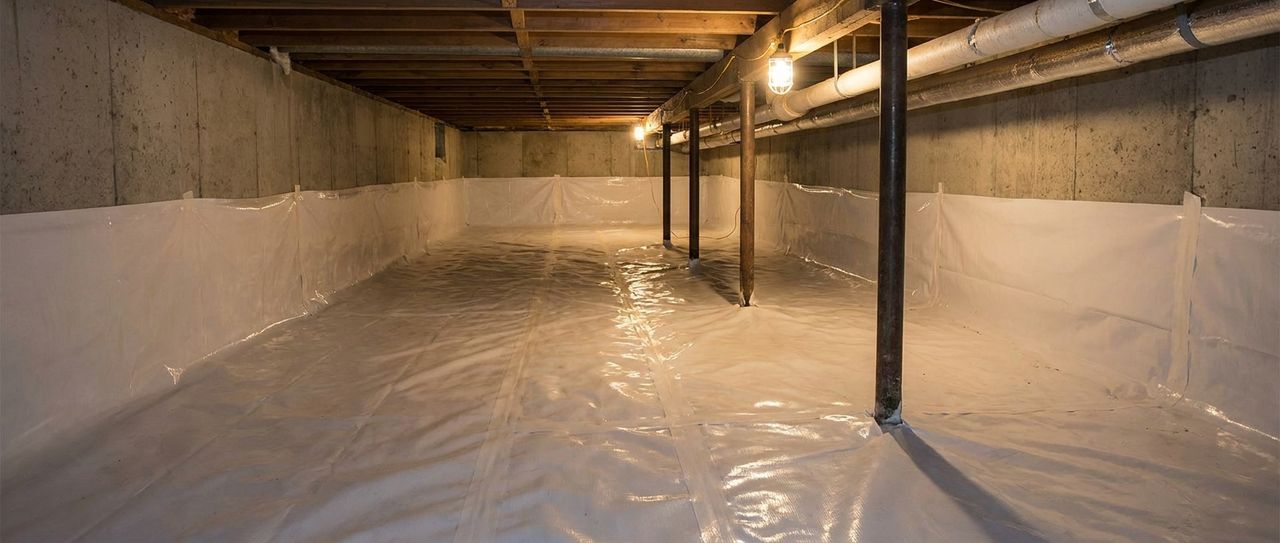
Encapsulation: Worth Doing While We're Down There
If you've priced crawl space encapsulation for moisture control, the overlap with radon work is obvious — both start with sealing a membrane over the dirt. The difference is that encapsulation alone doesn't depressurize the soil, so it can improve humidity and still leave the radon number high. The efficient move is one visit: encapsulation-grade membrane and wall treatment, plus the suction point and fan that make it a true mitigation system. You get a dry, clean, storage-friendly crawl space and a passing radon test from the same job.
A Sealed Crawl Space Earns Its Keep in a Great Falls Winter
There's a comfort dividend to this work that has nothing to do with radon. An open dirt crawl space in central Montana spends the winter radiating cold and damp into the floor above it — and Great Falls winters average in the mid-20s from December through February. Sealing and conditioning that space — the same membrane-and-seal work the radon system requires — is why encapsulated crawl spaces are standard practice in cold climates: warmer floors, steadier humidity, less freeze risk for any plumbing routed down there, and a space you can actually store things in. The radon fan is the part that moves the test number; the sealed membrane under it improves the house every day either way.
Mixed Foundations Are Normal Here
Plenty of the older homes we see around Great Falls are a story of additions: original basement, 1970s slab addition, crawl space under the porch conversion. Each zone leaks soil gas differently, and a system that only treats one can just relocate the problem. Diagnostics map how the zones communicate; the design ties them into one system or gives them separate suction points. It's a normal job with a normal price range — it just takes a company that actually checks.